Reactor Design
Reactor Design (SMR, MSR)
소형모듈원자로(SMR)와 용융염원자로(MSR) 같은 차세대 원자로의 개념 설계와 성능 평가
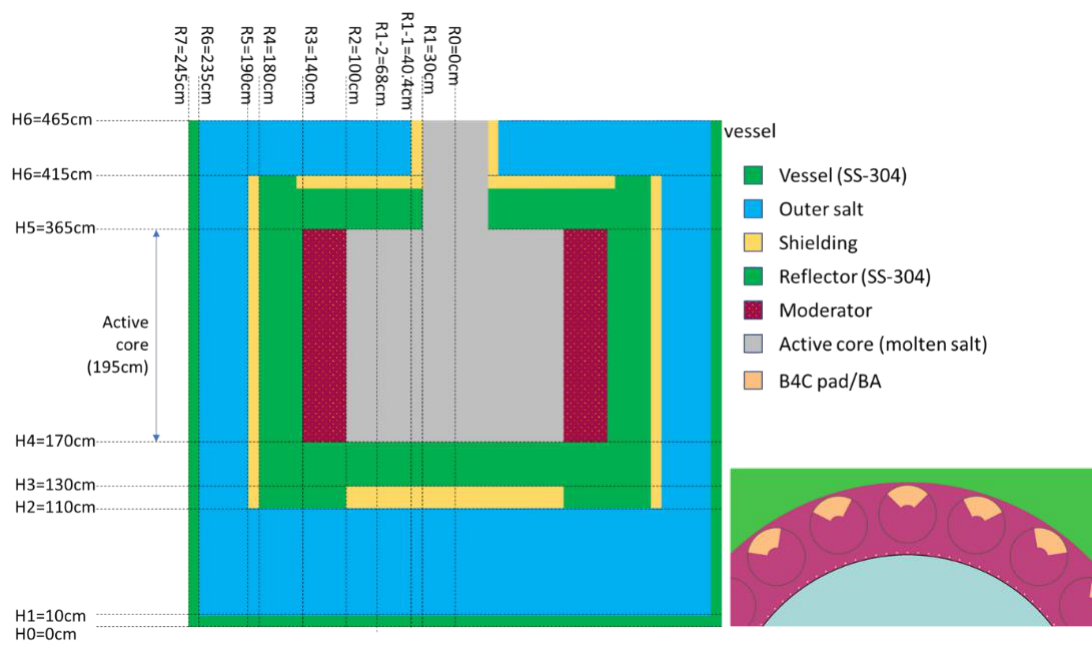
Advanced reactors such as small modular reactors (SMRs) and molten salt reactors (MSRs) rely on passive, natural-circulation-driven operation to achieve high inherent safety. ATHENA develops conceptual designs of these reactors and evaluates their performance by combining thermal-hydraulic experiments, computational fluid dynamics (CFD) and multi-physics simulation. Our main target is the Passive Molten Salt Fast Reactor (PMFR), a multi-purpose natural-circulation molten salt fast reactor, together with natural-circulation water-cooled SMRs.
Passive Molten Salt Fast Reactor (PMFR)
헬륨 주입으로 자연순환을 강화하는 다목적 소형 용융염 고속로 개념 설계
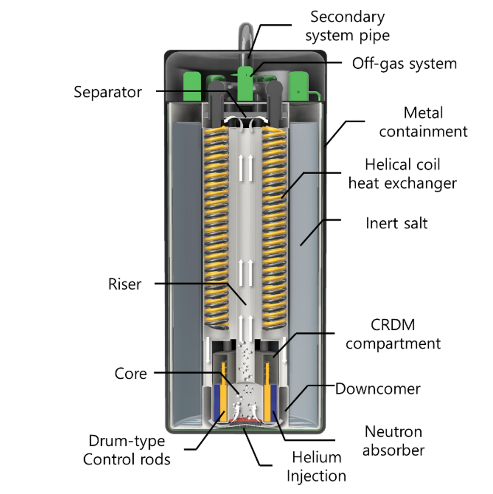
The PMFR is a compact molten salt fast reactor in which the fuel salt circulates without pumps. Helium injected below the core lifts the fuel salt through the riser, and the heat is transferred to the secondary system by a helical-coil heat exchanger integrated in the reactor vessel. The injected helium also removes gaseous and noble-metal fission products through the off-gas system. We establish the design concepts and requirements of the PMFR and evaluate its thermal-hydraulic feasibility, natural circulation characteristics and power-conversion options including hydrogen production.
Helium-bubble lift and two-phase natural circulation
헬륨 기포에 의한 자연순환 강화 효과를 실험 루프와 CFD로 검증
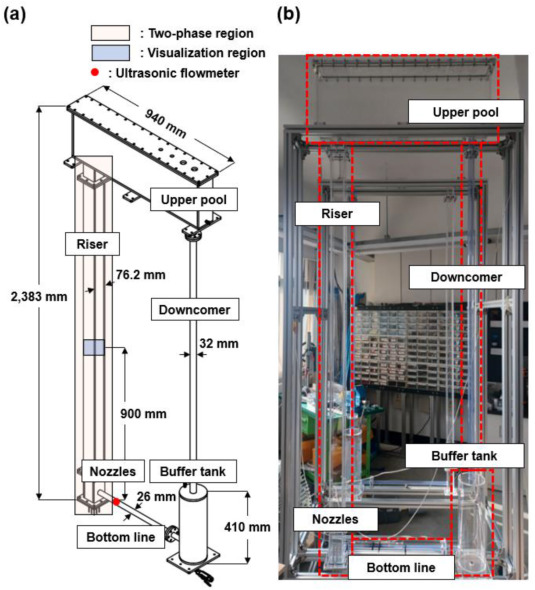
Injecting helium bubbles increases the buoyancy head and thus the natural circulation flow rate of the fuel salt. We quantify this effect with an adiabatic air-water two-phase loop equipped with high-speed visualization and ultrasonic flow measurement, and reproduce the results with CFD. Scaling laws are developed to link a lab-scale two-phase molten salt loop to the full-scale PMFR, including the distortion that arises from reduced height.
Multi-physics analysis of the MSR core
OpenFOAM·OpenMC·GeN-Foam 연계 해석으로 노심의 열수력-중성자 거동 평가
In an MSR, the fuel itself flows, so the thermal-hydraulics and neutronics of the core are tightly coupled: temperature and flow fields change the reactivity, and delayed neutron precursors drift with the salt. We couple CFD (OpenFOAM, GeN-Foam) with Monte Carlo neutronics (OpenMC, Serpent) to analyze natural-circulation-driven operation, core stability, the effect of flow-guide structures and the response to marine rolling motion for ship-based applications.
Natural-circulation SMR with on-demand flooding
금속격납용기와 침수안전계통을 적용한 무한냉각 자연순환 SMR 설계
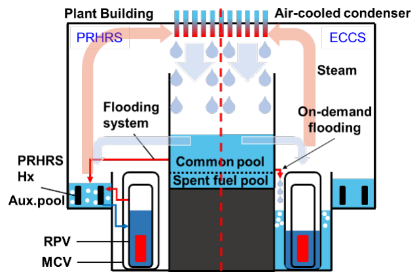
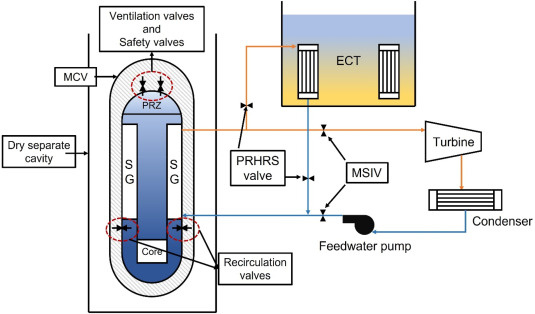
For water-cooled SMRs, we develop a natural-circulation SMR employing a metal containment vessel (MCV) and an on-demand flooding safety system. When an accident occurs, water from a common pool floods the gap around the MCV, and decay heat is removed indefinitely by boiling and condensation without operator action or external power. The design is evaluated with MARS-KS for extended-term cooling and multi-module configurations.