AI for Nuclear Safety
AI for Nuclear Safety
인공지능을 활용한 사고 진단·예측과 AI 도입의 신뢰성 확보
Severe accident codes take hours to simulate a single scenario, while operators must make decisions within minutes. ATHENA trains artificial intelligence models on large accident databases generated by MELCOR, MAAP and CINEMA to diagnose accidents and predict their progression in real time, and studies how AI can be adopted reliably in nuclear systems.
Accident diagnosis and progression prediction
제한된 계측 정보로 사고를 진단하고 진행을 예측하는 머신러닝 모델
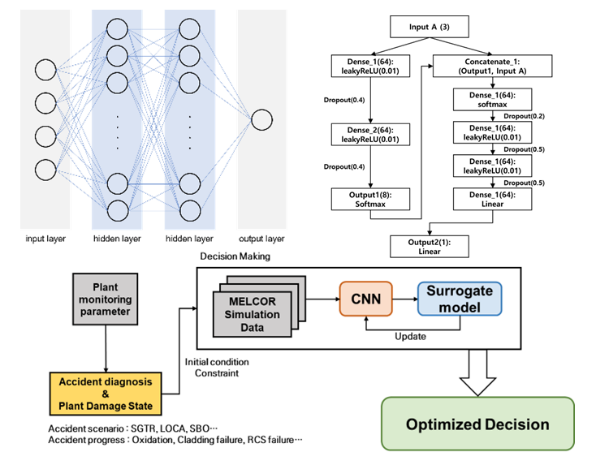
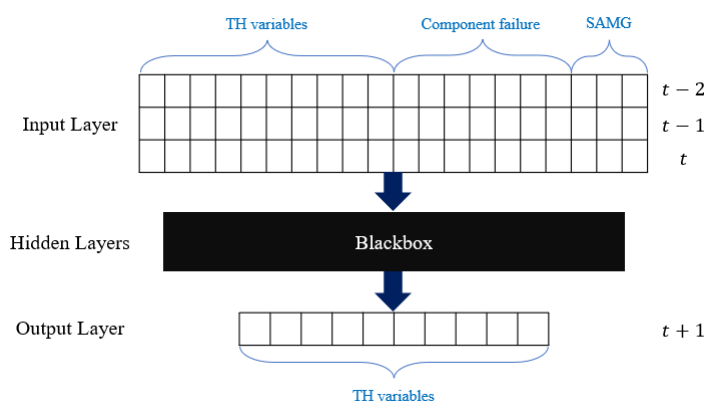
From plant monitoring parameters, our models identify the accident scenario and plant damage state and forecast the time evolution of key thermal-hydraulic variables. We use deep neural networks, CNNs and (Bi-)LSTM time-series models trained on thousands of simulated scenarios, and study how to detect core uncovery and predict cavity parameters with limited information.
Surrogate models and operator support tools
선량·방사선원항을 빠르게 예측하는 대리모델과 운전원 사고관리 지원 도구
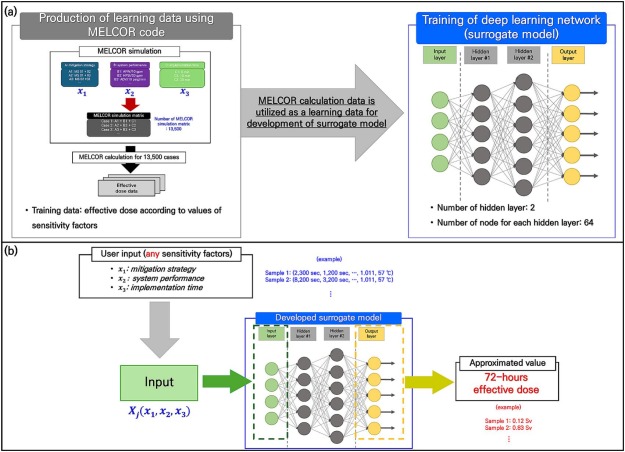
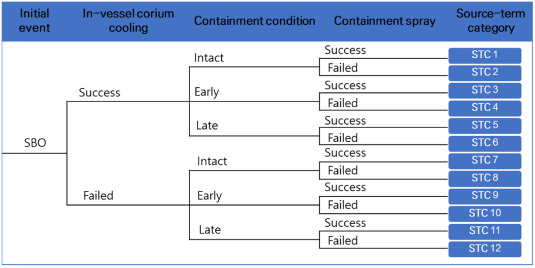
Surrogate models replace expensive code runs with neural networks that return results in milliseconds. We develop surrogate models that predict the effective dose for given mitigation strategies, system performance and implementation times, and an accident management support tool that classifies source-term categories with RNN-LSTM, aiming at practical support for operators' decisions.
Reinforcement learning and trustworthy AI
강화학습 기반 사고관리 의사결정과 원자력 AI의 신뢰성·규제 요건 연구
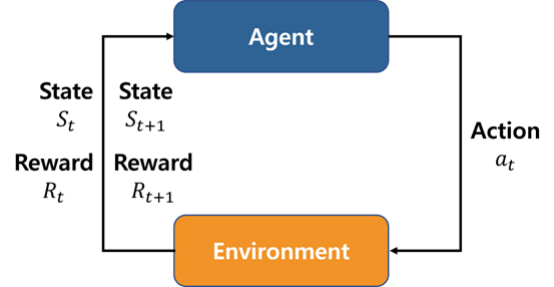
We explore reinforcement learning agents that learn accident management actions by interacting with severe accident simulations. At the same time, adopting AI in nuclear systems requires evidence that it is reliable. We survey AI applications in nuclear systems in Korea and abroad, assess their risk impact, and derive methodologies and regulatory requirements for ensuring the reliability of AI-based systems.